Last week @cheesemonkeysf wrote a great post about turning words into math. She invented the Phrase Translator sleeve with a sliding insert. Here's her picture.
I love this idea! I tried it using card stock and it was more difficult than I had anticipated. I'm left-handed and therefore a terrible cutter. I used card stock and it was too stiff- difficult to fold. I also felt like it was to skinny for me.
I tried making my own (because I just can't leave anything alone) and it took a while but I'm pretty happy with it.
Here's a picture of the two side-by-side.
Basically, mine requires less cutting because that's just something I need in my life.
Here is the sleeve (doc/pdf) and the insert (doc/pdf).
8.09.2012
8.06.2012
Made 4 Math #6 - Bonus Edition
Watch out people, I'm about to blow your minds.
Let's start with the easiest. This is not a craft, just an idea I like. I bought this small whiteboard with it's own magnetic eraser and marker to hang on the outside of my door.
That way when we go to the library/computer lab/outside I can leave a note in case a principal comes wandering by. Isn't the eraser adorable? I like the idea of a marker board because I wish people would leave me a note instead of interrupting my class. But I know the eraser and marker both will probably get stolen. That's ok, the board is my main concern.
Last year I checked homework for completion by walking around with my clipboard which I thought was awesome because it had a magnet on the back.
Also, I kept a master copy of whatever I was handing out to the class for each period to use as my guide. These often got mixed up with other random piles of papers which caused me distress.
Newly awesome clipboard to the rescue!
It opens up into a little storage bin.
Now I can keep my papers, keys, and pen inside and still use the outside as a clipboard! I attached a letter M (from Dollar Tree) to the back that can stand for Math or Miller and it's my favorite color. Winning.
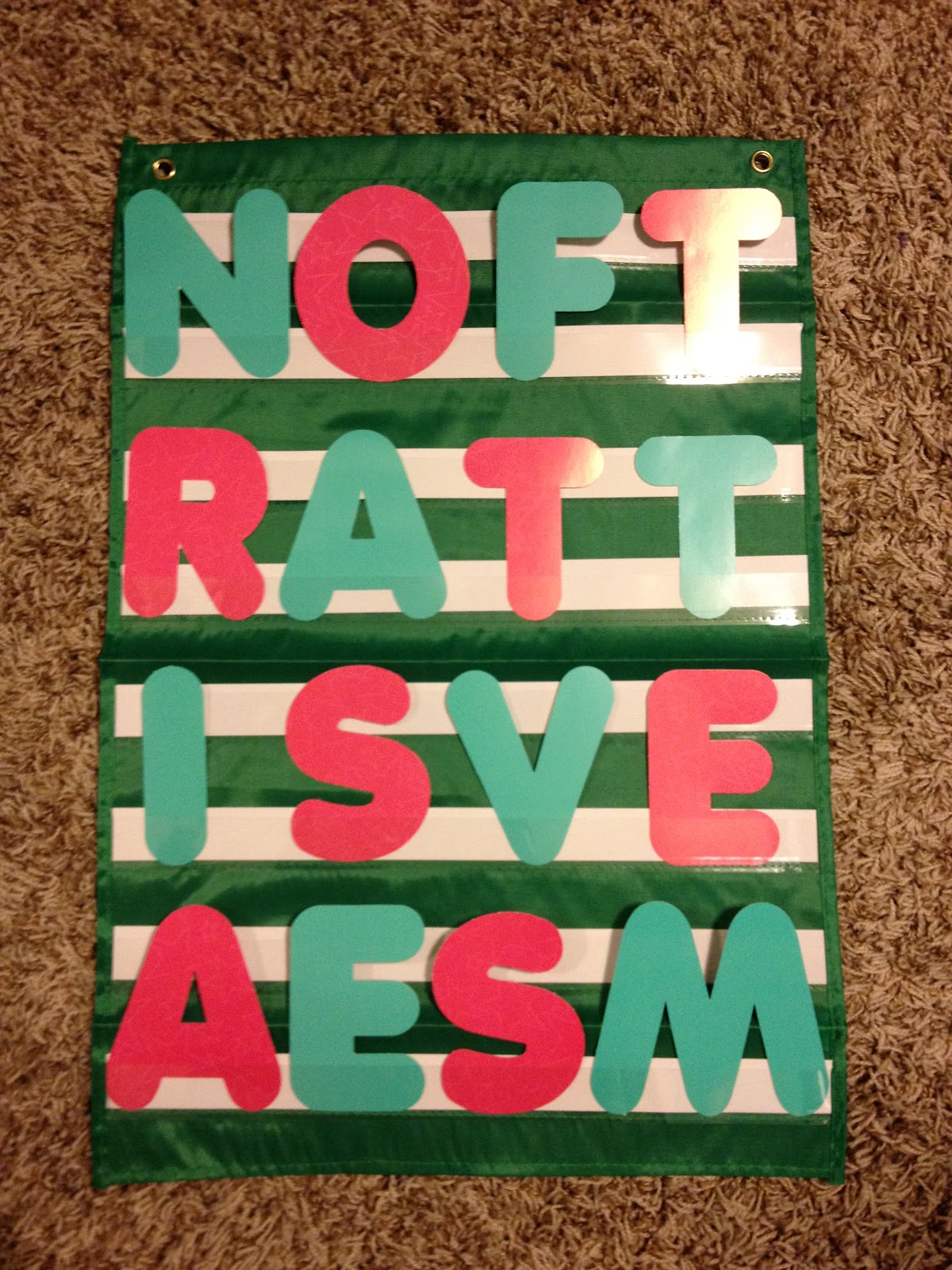
Next up, using my Dollar Tree letters and my $1 Target pocket chart, I created my own version of Boggle or as my phone likes to call it, Scramble Free. I actually used the game on my phone to pick which letters to put in there so that there would actually be words in it.
I think it's so cute!
Now on to my shining achievement. I made @mathtastrophe's ZAP review game all by myself and for only $3. $1 letters, $1 black foam board, and $1 index cards all from Dollar Tree. I used the index cards to make library card pockets because I have never seen those in real life. I took one index card turned sideways and folded it around a vertical index card, taped it shut, and a pocket was formed.
I made 16 of these and taped them to the board. I used my letters (which have appeared in everything I've made) to spell out ZAP! on the top and then I printed out the numbers 1-16 in a table (so they would all be the same size) and cut them out. Isn't she lovely?
I used some of @mathtastrophe's ideas for cards and added some in of my own. I redid them into strips of paper that I could fold in half and stick in the pockets. I don't know why but this just seemed easier and like a good idea.
It's amazing what you can do when you're made and determined not to leave your room!
Here are the numbers 1-16 and the points cards/slips. In case you were wondering, I used the font Katy Berry...which I love.
Next up, I went to school the other day but a) my whiteboards (for the walls) have still not been installed b) my floors have still not been waxed therefore c) all my furniture is scattered down the hallway. I've already had a nightmare about this so it has to be fixed. I ended up volunteering to present at our in-service on technology in exchange for getting my room fixed up pronto!
I digress. Anyway, I did a few things around the room. I organized my tubs and expandable files from last week's post into one filing cabinet drawer: go me!
Then I created my fantastic bulletin board! I bought 16 pieces of 12x12 scrapbook paper which were 50% off at Hobby Lobby. I bought a dry erase calendar from Hobby Lobby with my 40% coupon so it ended up being $4.79. I ordered this green fabric file folder organizer from The Container Store which I am still kicking myself for not buying it when I was actually at The Container Store. I had just enough room to hang up my Boggle game pocket chart and ta-da:
Love!
Tags:
#Made4Math
8.03.2012
#myfavfriday Quick Recipe + Favorite Websites
I don't cook so this is actually my mom's recipe but it is quick and yummy and the leftovers are great to take in your lunch. We usually have cornbread and green beans with this, since I know you were wondering.
Homemade Hamburger Helper
Step One: Brown one lb. hamburger in skillet. Sprinkle in dried onion flakes to taste. When hamburger is done, drain grease and return hamburger to skillet.
Step Two: Pour into skillet 1 small can tomato sauce. Rinse out can with half cup water and add to mixture. Add 1 Tbsp. brown sugar, 1/2 tsp. chili powder, 1/2 tsp. salt and 1/4 tsp. pepper. Simmer on low heat.
Step Three: Meanwhile, put on water to boil in 3 quart saucepan. When water is boiling, add approximately 8 oz. pasta. I usually use rotini, but last time I did bow-tie pasta and it was great. When pasta is done, drain and add to mixture in skillet. Mix well and bring to boil. Cover the top of the mixture with shredded cheese. (I usually use colby-monterey jack mixture.) Put a lid on the skillet and turn off the heat. Steam for about 5 minutes or until cheese is melted.
Now what I really wanted to share is some of my favorite websites.
Resources: When I first started teaching, I used ilovemath.org constantly. It has a lot of great hands-on activities, lessons, and games. But three years into this and I've pretty much used everything I could from there. Now I've started using betterlesson.com It's a fairly new website but when I searched for lessons on composite areas at the end of last year I literally found thousands of results and some pretty high quality resources. You may stumble across some things of mine on there and I apologize for that. They are mostly from the end of my first year and beginning of my second so not awesome. If you want something of mine to actually use, you would be better off searching the Lessons tag on this blog. And one more site, http://www.lpsmath.org/algebra1_calendar.htm, is great for algebra ideas. I especially like their lessons on functions because there is a real function machine that chugs outputs from your inputs. Sometimes I use the lessons or sometimes I just use it to guide my pacing.
Storage: I use and love box.com more than other websites I've tried. I first used dropbox.com and then attempted to use sugarsync.com Both of these supposedly automatically sync your files from one computer to another. So theoretically, you could create something at home, save it, and it would automatically appear on your school computer. It never quite worked out for me but I'm pretty sure that was because our school computer server is wonky. I used googledocs for a while but I hate how it changes my files to fit their formatting. I've never had any problems with Box. I can share my folders or keep them private. I can add collaborators to my folders. I can make folders! Anyone can view my box files, even without a box account. And it prompts people to download my file so they can see it in all it's original glory. I don't have to worry about any syncing because it's internet based. I can log in anywhere and all my files are right there. It has definitely been the most consistent and convenient for me.
Hmm...I thought I had more to share but that's about all I can think of for now.
Tags:
#myfavfriday
7.31.2012
2012-2013 New Beginnings
I met with my instructional coach yesterday and we came up with a lot of good ideas that I'm ready to try and hoping will work.
Bell Ringers: I will no longer cut and print these. I will have half sheets of blank paper on the shelf (along with golf pencils) for students to grab as they come in. Bell ringer problems will be projected on the screen. They will be a review of the previous grade, concepts students should know and be able to do without my assistance. I plan on trying to do 3 questions per day and a different concept on Monday, Tuesday, and Wednesday. The first week the problems will have hints and formulas. The second week I will take those away and the students will do the same type of problems. So the students will see 3 new concepts every two weeks. Hopefully, this will build in some retention of the earlier concepts as well as start every class off with each student experiencing some kind of success. I also plan to try Amy Gruen's green pen idea (except with purple probably) where I star a students bell ringer (when it is correct) and then give them a purple pen to coach/star someone else and so on.
Homework: I am giving up on grading homework. Even though I've only graded it for completion so far anyway, it still is just...bleh. I am going to quit calling it homework and call it a practice sheet. Every day I will post the answers to the practice sheet and answer questions. Next, I am going to give a practice quiz every Thursday by picking a few of the most important homework problems from the week. These will be the exact same questions from the homework, same numbers and everything. Students who did the homework and asked questions will do well and students who didn't really need to do the homework can still do well. The people who won't do well are those who needed to do the homework but didn't. Hopefully that will teach them that practice does have a purpose. Should I let them use their homework or will that just encourage asking me how to do every single problem in class and writing it down to use for the quiz?
Exit Slips: Students will use the back side of their half sheet from the bell-ringer to answer a question projected on the SMART board. When they leave, they will stick their paper in a green, yellow, or red folder attached to the door, based on how well they understood the day's lesson. I can judge based on how they feel as well as the worked out problems what to do next.
Summarizing: Earlier I posted my math portfolio idea. Now I've decided that it's entirely too much. I want to have students write skill descriptions but I just don't know how practical it is. One piece I do plan to use is my unit summary sheet. At the end of each section we will do summary bingo. I [left this blog post and took about three hours to say that I] created a summary bingo powerpoint with 25 different summarizing questions. I actually have a bingo game where you spin the wheel and a chip pops out. I will take all the bingo chips out that aren't an option so that every day we can spin the wheel, a chip pops out, and we choose that summary question for the day. Students write their answer to the question and keep the sheet in their binder. Then do exit slip, drop in folder on the way out, the end. I am concerned on how long it will take to do a summary question and exit slip. I probably won't do both every day so I guess we will just see how it goes.
Unit Review: I'm not sure how this will work since I am attempting sbg this year [again!] and not having unit tests. I guess if I quiz more than one concept at a time, maybe? Not sure. We are going to go back through our notes and highlight the main ideas of each section. This, combined with the unit summary sheet, is going to be a good way to summarize and review the unit while hopefully teaching a study skill. I'm also going to try to build in a summary space throughout our notes instead of leaving it all to the end. Summarize, summarize, summarize!
Classroom Management: Thanks to @approx_normal my official classroom management mentor, and my instructional coach, I hope I have a better handle on how to deal with issues in the classroom. At some point in the beginning of school, I'm going to discuss two things with my classes: an atmosphere of respect and an environment for learning. We are going to split the board in half and brainstorm what both of these things should look like and sound like. From there, the first time something happens that [minorly] disrupts either of those, I'm going to quietly ask the student to see me after class. I'm going to remind them that their behavior is disrupting my teaching/interrupting other students' learning and ask what they can do to remember not to do that again. Then tell them the next time it happens I will have to write a referral. The next time it happens, I will again tell them to see me after class. I will apologize that I now have to write a referral. My IC advised me to keep it from seeming like these things bother me personally and keep the focus on the class and interrupting learning. She told me I stick my head in the sand and ignore things when they happen. Similar to Hedge telling me I'm not committed to changing anything. Hmm...She also said that when I get in a bad mood, I tend to turn away from the kids and ignore them which makes them feel like I don't really care how they act anyway. I know this approach isn't as B.A. as @approx_normal is, but hey, what is?
The important thing is I think it fits me. I think I might actually be able to do this.
See Me After Class Cards: This is a brainstorm I just came up with. I'm thinking of creating a little See Me After Class card that I can quietly drop on a student's desk as I walk by. If there is a discipline problem, I can drop the card and leave the kid squirming, wondering if they will get written up. If a student does something good, I can also drop the card and later reward/praise them for their behavior with one of my cute new cards. Although the good kid will then be squirming too, possibly thinking they did something wrong. Maybe I should just drop the cute new card on the students desk instead of asking them to stay after. But I kind of like the idea that a student doesn't know exactly why I'm asking them to stay after. What do you think?
Bell Ringers: I will no longer cut and print these. I will have half sheets of blank paper on the shelf (along with golf pencils) for students to grab as they come in. Bell ringer problems will be projected on the screen. They will be a review of the previous grade, concepts students should know and be able to do without my assistance. I plan on trying to do 3 questions per day and a different concept on Monday, Tuesday, and Wednesday. The first week the problems will have hints and formulas. The second week I will take those away and the students will do the same type of problems. So the students will see 3 new concepts every two weeks. Hopefully, this will build in some retention of the earlier concepts as well as start every class off with each student experiencing some kind of success. I also plan to try Amy Gruen's green pen idea (except with purple probably) where I star a students bell ringer (when it is correct) and then give them a purple pen to coach/star someone else and so on.
Homework: I am giving up on grading homework. Even though I've only graded it for completion so far anyway, it still is just...bleh. I am going to quit calling it homework and call it a practice sheet. Every day I will post the answers to the practice sheet and answer questions. Next, I am going to give a practice quiz every Thursday by picking a few of the most important homework problems from the week. These will be the exact same questions from the homework, same numbers and everything. Students who did the homework and asked questions will do well and students who didn't really need to do the homework can still do well. The people who won't do well are those who needed to do the homework but didn't. Hopefully that will teach them that practice does have a purpose. Should I let them use their homework or will that just encourage asking me how to do every single problem in class and writing it down to use for the quiz?
Exit Slips: Students will use the back side of their half sheet from the bell-ringer to answer a question projected on the SMART board. When they leave, they will stick their paper in a green, yellow, or red folder attached to the door, based on how well they understood the day's lesson. I can judge based on how they feel as well as the worked out problems what to do next.
Summarizing: Earlier I posted my math portfolio idea. Now I've decided that it's entirely too much. I want to have students write skill descriptions but I just don't know how practical it is. One piece I do plan to use is my unit summary sheet. At the end of each section we will do summary bingo. I [left this blog post and took about three hours to say that I] created a summary bingo powerpoint with 25 different summarizing questions. I actually have a bingo game where you spin the wheel and a chip pops out. I will take all the bingo chips out that aren't an option so that every day we can spin the wheel, a chip pops out, and we choose that summary question for the day. Students write their answer to the question and keep the sheet in their binder. Then do exit slip, drop in folder on the way out, the end. I am concerned on how long it will take to do a summary question and exit slip. I probably won't do both every day so I guess we will just see how it goes.
Unit Review: I'm not sure how this will work since I am attempting sbg this year [again!] and not having unit tests. I guess if I quiz more than one concept at a time, maybe? Not sure. We are going to go back through our notes and highlight the main ideas of each section. This, combined with the unit summary sheet, is going to be a good way to summarize and review the unit while hopefully teaching a study skill. I'm also going to try to build in a summary space throughout our notes instead of leaving it all to the end. Summarize, summarize, summarize!
Classroom Management: Thanks to @approx_normal my official classroom management mentor, and my instructional coach, I hope I have a better handle on how to deal with issues in the classroom. At some point in the beginning of school, I'm going to discuss two things with my classes: an atmosphere of respect and an environment for learning. We are going to split the board in half and brainstorm what both of these things should look like and sound like. From there, the first time something happens that [minorly] disrupts either of those, I'm going to quietly ask the student to see me after class. I'm going to remind them that their behavior is disrupting my teaching/interrupting other students' learning and ask what they can do to remember not to do that again. Then tell them the next time it happens I will have to write a referral. The next time it happens, I will again tell them to see me after class. I will apologize that I now have to write a referral. My IC advised me to keep it from seeming like these things bother me personally and keep the focus on the class and interrupting learning. She told me I stick my head in the sand and ignore things when they happen. Similar to Hedge telling me I'm not committed to changing anything. Hmm...She also said that when I get in a bad mood, I tend to turn away from the kids and ignore them which makes them feel like I don't really care how they act anyway. I know this approach isn't as B.A. as @approx_normal is, but hey, what is?
The important thing is I think it fits me. I think I might actually be able to do this.
See Me After Class Cards: This is a brainstorm I just came up with. I'm thinking of creating a little See Me After Class card that I can quietly drop on a student's desk as I walk by. If there is a discipline problem, I can drop the card and leave the kid squirming, wondering if they will get written up. If a student does something good, I can also drop the card and later reward/praise them for their behavior with one of my cute new cards. Although the good kid will then be squirming too, possibly thinking they did something wrong. Maybe I should just drop the cute new card on the students desk instead of asking them to stay after. But I kind of like the idea that a student doesn't know exactly why I'm asking them to stay after. What do you think?
Tags:
Strategies
7.30.2012
Made 4 Math #5- Organizing Unit Activities
I love sorting! I like to create activities for students to sort things and find patterns and make predictions. Or just anything hand-on that makes math concepts come to life.
I did very few my first year up to quite a few my third year. So after three years, I had accumulated a large pile of activities. Before school ended, I cleaned and organized my room. I began to find activities I had forgotten about. I started throwing them all into one filing cabinet drawer for "later".
Later finally came.
While in St. Louis for #TMC12, I visited a Dollar Tree and bought 8 cute bins. Then I went to school and dragged everything out of that hideous drawer and stuffed it in a trash can. Literally, I couldn't find anything else to carry all that crap in.
I brought them home and gave them the evil eye all night long. Finally, I made a deal with myself that I would organize them into three piles (Algebra I, Geometry, Algebra II) and leave the rest for the next day.
From there, I sorted activities in the order I teach them for each class. I put everything I could into expandable files. All the overflow was then sorted into bins. Of course I wanted to color code but my expandable files were pink, purple, and teal and my bins were green and blue. So I ghetto color coordinated: I just used pink, purple, and teal index cards taped inside each bin to label the contents.
Now everything looks so nice and pretty! But then I will go to school and shove all these into a drawer. How will I ever find anything? How will I avoid making the same activity twice? (Yeah, that happened.)
A handy-dandy spreadsheet to the rescue! (Now, if I was Julie it would be a google doc, but I'm not Julie). I made a tab for each course and of course- color coordinated- pink, purple, and teal. Then I typed in what was in each tab and if there was a corresponding bin. I even color coordinated the text in each tab! Yay for color!
Now I can easily see what I have for each unit and easily add in (hopefully) new activities.
I did very few my first year up to quite a few my third year. So after three years, I had accumulated a large pile of activities. Before school ended, I cleaned and organized my room. I began to find activities I had forgotten about. I started throwing them all into one filing cabinet drawer for "later".
Later finally came.
While in St. Louis for #TMC12, I visited a Dollar Tree and bought 8 cute bins. Then I went to school and dragged everything out of that hideous drawer and stuffed it in a trash can. Literally, I couldn't find anything else to carry all that crap in.
I brought them home and gave them the evil eye all night long. Finally, I made a deal with myself that I would organize them into three piles (Algebra I, Geometry, Algebra II) and leave the rest for the next day.
From there, I sorted activities in the order I teach them for each class. I put everything I could into expandable files. All the overflow was then sorted into bins. Of course I wanted to color code but my expandable files were pink, purple, and teal and my bins were green and blue. So I ghetto color coordinated: I just used pink, purple, and teal index cards taped inside each bin to label the contents.
Now everything looks so nice and pretty! But then I will go to school and shove all these into a drawer. How will I ever find anything? How will I avoid making the same activity twice? (Yeah, that happened.)
A handy-dandy spreadsheet to the rescue! (Now, if I was Julie it would be a google doc, but I'm not Julie). I made a tab for each course and of course- color coordinated- pink, purple, and teal. Then I typed in what was in each tab and if there was a corresponding bin. I even color coordinated the text in each tab! Yay for color!
Now I can easily see what I have for each unit and easily add in (hopefully) new activities.
Tags:
#Made4Math
Subscribe to:
Posts (Atom)