Prompt:
“Though this virtual conference is focused on humanizing mathematics, it sometimes helps to think about the opposite. De-humanizing mathematics. Please share a time when doing mathematics was a dehumanizing experience for you.”
-The Virtual Conference on Humanizing Mathematics
Generally I did well in school in all subjects up until college. I can only remember one terrible time when I was in second grade. I wasn't understanding a concept and I remember telling the teacher that I didn't understand, almost in shock....because it didn't happen to me very often. And the teacher said "Well you better jump on the train because it's leaving the station."
I remember instantly feeling butterflies in my stomach and tears in my eyes and literally imagining a train with my whole class and teacher leaving me all alone. "But I don't know how to get on the train!"
And now I have no idea how the situation resolved or any other details.
Fast forward to high school. Again, I did well in school, I was salutatorian, did well on standardized tests, helped others with math, on the math team, etc.
And then college was a brick wall. I cried nearly every day and called my mom to say I couldn't do this. I had decided to be a math teacher because math was like a puzzle to me and I felt like math was actively learning new skills instead of just memorizing facts like the other subjects. But truly, all of my college math classes felt like they were in another language. I had no idea how this connected to anything I would ever teach in high school. How was Calculus and Modern Algebra and Discrete preparing me to teach high school math? How was it that no one else was struggling but me? How was it that I was the top of my class and struggling so bad? How would the rest of my class make it?
I went to the math lab for peer tutoring every day after class. I went to office hours all the time with my professors, usually not even knowing what to ask, but knowing I needed help. Honestly, I still don't really know how I passed most of those classes.
One of my classmates was the same age as me and was also becoming a high school math teacher. I felt like she was my equal in so many ways. I could tell she had been successful in high school and active in clubs. She was friendly and confident, things I had been in high school but somehow had completely lost in college. So how did this all come so naturally to her? She was actually a tutor in the math lab...for the same class we were taking!
I would hear people talking about future math classes we would have to take and literally imagined the words swirling around my head...how could I know so little? How could I hope to teach anyone anything about math?
I made it through, mainly because I'm not a quitter. And I only ever wanted to be a teacher so.....I had no back up plan. lol
One day I was at church talking to some friends, basically have a break down over everything. And my friend says "Ok, what do you love doing? What makes you excited? What problem do you want to fix? What comes to your mind first?"
And my response was "to help people when I see confusion." Like I wish I could speak other languages so I could help people who aren't understanding.
So he says to me..."Elissa, you want to be a teacher."
Why did I need to hear someone else say what I already knew to be true?
I honestly don't know how I made it through those classes or how any of that helped me. I really and truly don't. I still don't know any Calculus. I don't know the big picture of the things that I'm teaching. I don't know how everything connects.
When I go to TMC and we have to do math, I always hesitate. I already know that I don't know what to do. I already feel ashamed that other teachers do this for fun and I don't know how to start. I'm not afraid to ask questions but I am afraid to ask too many questions. So I wait, hoping to figure out the one question to ask that will magically unlock all the understanding for me. Or I just clench my teeth and wait for it to be over and get back to teaching strategies.
Honestly, doing any math about Algebra 2 is still dehumanizing to me. It still makes me feel like a fraud.
I am a better teacher than a mathematician. I will never get any more degrees in math or discover any theorems.
But my gifts and my experiences shaped me into a teacher who does two things: explains how to get on the train and doesn't let the train leave anyone behind.
Anytime a student mentions that I never leave anyone behind or that I try to make sure everyone understands, my second grade self smiles.
When I am teaching a new concept, I look for the butterflies and wanting-to-cry-eyes so I can explain more, better, again.
Whatever it takes for all of us to leave the train station together.
P.S. Remind me of this post the next time I complain about never getting far enough through the pacing guide. ;)


7.29.2019
Made 4 Math Monday: Teacher Toolbox and Puzzle Wars
This is about the third time I've redone my teacher toolbox, but still cute and still worth showing.

I printed them, laminated them, cut them apart, and then taped them on the inside of each drawer with tape on the bottom and top of each label. Here are the labels and the font is KG All of Me.
On top are juice mix boxes decorated with tape to hold sets of pens. On the left is a Pringles can covered in duck tape to hold rulers.
This summer I read about puzzle wars on Pinterest. My version is four things that

I want an average of 80%+ for their grades and attendance. I put pencils inside of a straw holder taped to each desk. If 0% of the pencils are missing by the end of each week, they win the puzzle piece. I have a 'two nice things' rule where they have to say two nice things every time they say something rude about any person. So if the rule isn't used for a week, they get the puzzle piece.
Green is Geometry, blue is Algebra I, purple is Algebra II, and pink is Trig. I printed the puzzle out twice on legal-sized paper and colored them. I laminated them and then cut one of them up in to pieces. The pieces are stored in the adhesive pockets below. The pockets came from Target Dollar Spot last year.
Here is the puzzle if you are interested and the font is also KG All of Me.
7.23.2019
One Small Change
One of my favorite things about Twitter Math Camp was when teachers would share something they do in their classrooms that has a made a difference...not a huge overhaul or system or curriculum. Just a small thing. I didn't want to go a school year without it so I asked Twitter and got a great response! I wanted to share so that everyone could follow links and such a bit better.
Sandra Goodrich:
Student reflective writings. When I have students take the time to seriously reflect on the assignment and their understanding of the essential question, we both learn. The practice must be established at the beginning of the year, and the initial reflections have to be challenged for depth. Do you know what I mean? They have to do redo's. "Graded" in the way homework is graded - did they do it? ✅ But it does mean reading them and helping them progress in critical thinking.
Jennifer White:
I moved practice to the next day. So every period goes: -warm up -20-25 min practice previous day(s)/week’s stuff -20 min new material -closing The lagged practice feels more productive to me and kids agree. They say it helps with absences too bc they never feel out of the loop. It was such a small change that made such a huge difference!! Class periods are one hour. So it’s about half and half practice and lesson. So for instance, we’d spend 20 minutes (maybe 15 one day if hey don’t need a lot for a skill) doing question stacks or some other self checking practice and I guide/help when needed. We will see the topic again in a practice in a few days. And the. Again on the optional HW. Aside from students liking it and saying it helped (which is the main awesome part), I really enjoyed that it didn’t require me changing much. I still planned the same. Just taught one day and practiced the next (which is another awesome side effect 😂)❤️. I do this in both of my classes (geo w/9-10 & 4th level math w/11-12). Hw is suggested but not graded and lagged from previous week (@hpicciotto has blog posts about this) Ss do the hw even though it’s not graded bc we talk about how learning happens and the need for practice.
(Henri Picciotto resource)
(Alli George and Anna Vance resource)
Laurie Brewer:
I give a one or two question quick exit tickets several days a week. I stand over my trashcan in the afternoon and throw away all who show understanding. I keep those clearly struggling or lost. I pull those kids for small groups the next day.
Megan Heine:
This is somewhat in response to your "what do I do with the exit tickets?" in addition to what the other students are doing... 1. I have a final countdown in which the Ss rate themselves 1 -5 (1 - I don't get it & need re-teaching, 5 - I can teach someone else). The final countdown is a Google Form and when the song plays - they get it from Google Classroom. 2. I skim through the Google Sheet every day before I leave and make sure to note of those at a 1 or a 5...The next day's practice time is always "differentiated" or at least there are different options for students during the practice. So if I need to pull a group for re-teaching, the others are working on other types of practice....If a lot of students are at a 1 - I find a new way to explore or discuss the topic with the "whole" class... if there are some who don't need it - they are free to go straight to the practice....I use the same routine every. single. day. So once we get into the routine of the Do Now and the Final Countdown, there's definitely less time wasted. But I understand that pain very well. Next tweet on practice coming...I use @MrDeltaMath a TON for this. Each assignment has a name to identify the level of practice (BEGINNER, PROGRESSING, MEETING, ADVANCED). Those are the names of our district's level of proficiency. Then I also use the plastic dry erase pockets. I color code the practice in the dry erase pockets. So all the reds are Beginner, etc... I know what Ss are working on based on the color of their dry erase pocket. One more way I use differentiated practice is through Question Stacks and Scavenger Hunts... (one more tweet)Question Stacks are done by level as well... once students feel comfortable, the scavenger hunts are a MIX of all the levels. I usually do 2 scavenger hunts (one is in my room (Beg - Mtg) and the other in the hall way (Prog- Adv). Shoot me questions! (it's def not perfect)Lately, I've found Ss are grateful to be working on stuff at their level & not having to do stuff they're not ready for. No, Ss are not always on their CB's but I have them bookmark my Google Classroom, Delta Math, and the Google Form we use every day for quick access. I'm very deliberate about the language I use in class in regards to "your pace", "your level" and how it does not matter where you are as long as you are growing and learning. (I use a lot of my own stories to demonstrate this).
Druin: positive difference with students... high fives positive difference mathematically... number talks
Kent Haines:
Lagging homework! I like to interleave a couple of different skills starting roughly 3 days after they first saw it. So they could see it a few days in a row, but not immediately once they learned it.The last few nights of homework are effectively a study guide for the test, so it's on there but yeah, they don't get as much practice with that last concept (so I try to make it an extension of a big idea rather than a new big idea).
Ethan Weker:
Class playlists. Each student chooses their theme song. I use a random playlist for the class to choose students to share their work. Generally the song plays until they finish or the song finishes. For some interesting long problems, sometimes a second song comes on and they tag team the solution. It can be pretty dynamic Huge reward for minimum (and fun) setup. Absolutely I play it while they are working. (They often are willing to take more chances, work longer, and share more work.) I use Spotify (but I'm sure any good streaming service would work). It tends to have most things that kids request, plus I can justify having it for myself outside the classroom. I do filter explicit lyrics, and remind students to find school appropriate songs or at least radio edits. So far it hasn't been a problem, as far as I know. (Some songs are in Korean, Chinese, or Spanish, and I just can't be sure, but I trust my kids).
Jeremy Thomas:
I stopped telling students to "show their work" and instead made it "show your thinking" ...small change but huge difference! think “show your work” tells S’s to write only what they have to while they are getting the answer. But “Show your thinking” tells them to write the process their brain went through, even if they didn’t have to write it down.
Rachel Rosales:
I seat students in groups. I have had a lot of success randomly grouping each Monday (or every other Monday).
Bernard Soong:
Getting to know at least 1 thing about each person (student) I work with. Relationships. That is, not where they sit or their academic strength/weakness, but something about them, something they're interested in, etc. In secondary, that's over 200 students. As admin, it is 100's
David Wees:
Increasing wait time after asking a question and wait time after hearing a response is also a relatively small change that can be really productive, assuming you haven't worked on this already. Once a student has responded, everyone needs time to process their response, assuming the questions you ask require some thought (which they should), so increasing wait time after a response comes in is helpful. Also, if students are given a bit more time to answer, they tend to give a bit more information, so wait time after a response can also improve the quality of responses, and consequently, the quality of thinking done by students. Finally, YOU also get more processing time and are more likely to be able to hear what the student said and consider what you want to do next if you have even a bit more time. See @Trianglemancsd's talk on Listening to Students for more on this point.
Alethea Vazquez:
To add to what David said have them write their thoughts first. Gives those reluctant ones time to process and something to refer to when sharing. Ask yourself “why?” Sometimes we do or assign things just because. When I started asking “why” I did certain things it really effected my teaching. If the answer doesn’t support S learning then I tossed it!
Pam J Wilson: Wait time after the response gives everyone time to process. As well as asking other students if they agree or disagree and why to the response. When I was at my peak, questioning. In Philly @davidwees shared 3 types of Qs stop thinking, proximity and start thinking. As Ts, we should not answer the first two types. (https://t.co/jIgJnoMQVH)
annmariastat
Yes, I got that tip from a professor in teacher Ed. I just silently count to 10 in my head before I say anything else.
Amy:
I really try to respond to questions with questions instead of answering them right away. Try to pull the answers out of my students.
Matt Coaty:
Giving out unit study guides at the beginning of a unit instead of right before the test. One of the issues I had last year was that some students wanted to complete the entire study guide once I passed them out. As we explored concepts I'd remind them that it'd be a good idea to work on those skills on the study guide. It was much smoother after the first unit. I don't think they forget the earlier stuff if part of the class time is dedicated to review. Spiral homework also plays a role to help reinforce and remind students. Also, not everyone completes the study guide at the same pace/time so that's factor.
Tom Hall:
Similar idea to @Mcoaty, I passed out study guides earlier. I also took the 2 study guides I normally passed out each unit and split them into 4 worksheets, so reviewing was paced throughout the unit. It might sound overkill, but there's only one complete unit each in the 1st and 3rd quarters for the curriculum in my district. Tests reflect a lot of ideas.
Brooke Tobia:
We start our math class with Board Meetings everyday. It made a huge positive impact on our class culture and collaboration skills and really can be done anywhere at anytime! 3-50 min classes and 1-2 hr block👍🏻 We have worked on the idea of collaboration a lot in our class. I taught and encouraged Ss who understood the concepts to ask thoughtful questions in order to guide others. We also try to just use one marker for each group to encourage the sharing of ideas😜
Deb Vigna:
Using Visual Thinking Strategies
ann.on.a.mouse:
My class routine: Come in. Sit down. Begin. By teaching students that THEY are responsible for starting class, we gain 5 to 7 more minutes of class time.
Shannon Sirois:
Putting a larger amount of my focus on relationships. Not thinking time building relationships in class is time wasted. Realizing that 99.5% of behavior I see isn’t a reflection on me. It shows me what they’re dealing with outside of my classroom. Studying Trauma Informed Ed. Paper Tigers documentary is great! It gives a good starting point. A lot of my learning has been through PLC
Patti Sprague:
Greet kids at the door is my simplest change that elicits a big response. I added "passwords to enter" at my door this year. Positive affirmations kids can choose or make up their own. Usually they pick what they need me to say to them that day. We worked a lot on math mindset and this helped. I also gave kids the option to use their password silently. These are what we started with:
 They say them to themselves and I eavesdrop. 🤣 Usually 1 or 2 Ss aren't comfortable saying it out loud so they point or just think it. What and how they choose tells me a lot about how they're feeling each day. Then as everybody comes in I share which one I choose for the day.
Robin Matthews:
1. Play music while they are working. They pick the apple radio station. 2. Visible Random Pairings that change daily. 3. Standing & working vertically with their partner. No hiding. Can see the work of others if needed. I can easily see everyone’s work. They don’t have to agree. I ask, I play 1st one said. I make sure to not always have it be the same person. In general, they love the 00’s playlist. I set up to block explicit songs. I can’t tell you how often my classes are standing, doing math, & singing together.
Diana Kolhoff
Think - Pair - Share So simple. So impactful. Keeps Sally smarty-pants from calling out, gives everybody a chance to process and be accountable for their thinking. Literally any Q you would normally ask. It’s a subtle shift in process away from traditional hand raising or letting Ss call out.. Low level Qs: think, whisper to a partner, everyone say it together. Higher order Qs: think, turn and talk, who wants to share what they discussed.
Emily:
I do a think - ink - share too. Have Ss write the answer before sharing w/a partner or small group. I'll spot check the writing to see thought process
Briana Guzman:
I have my students rate themselves using our grading rubric and why they rated themselves that way on a sticky note. Then on their way out the door they stick it to a poster in “bar charts” so I have a quick snapshot of their perceived understanding. If confidence is low we work on some more problems the next day. I have them make goals for themselves and talk about how we can move the bars so that the level of understanding is higher.
Michael Reitemeyer:
Daily randomized groups. Both for sitting and working. It really helped create a class community rather than pockets of collaborators. And it really helped reduce status issues in the class.
Sara Tenan Gray:
I came in one hour early every Monday. Turned on my happy music and prepped to set the stage for the week. For whatever reason, that one hour made me feel so much more in control and in front of what was to come. It set a tone that I had it all under control.
Heddin Bjornsson:
Giving verbal in class fleedback on written assignments, while the other Ss are working on standard problems. It frees up a lot of time for me to make more interesting lesson plans and new assignments, and my Ss get so much more training and more useful feedback. Project rapports, word problems and theory presentations. What ever I think they will need more than a class room presentation of a solution.
Jeffrey Watson:
Read the Language chapter of “Cultures of Thinking.” It will suggest changes that are easy, and that cost nothing.
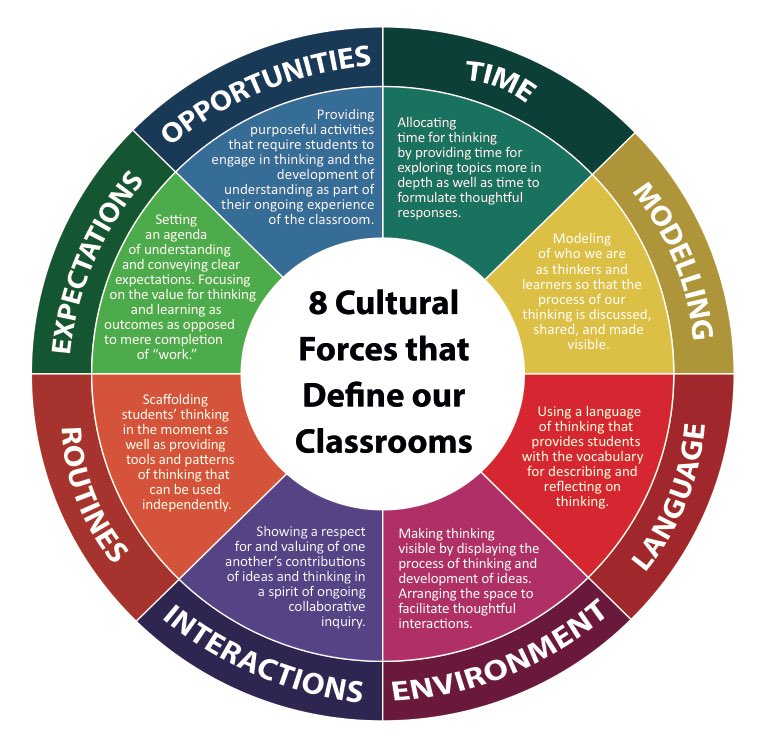
Crissy Mombela:
Before the beginning of a unit, I did a brief overview of what they were about to learn, then I had them write permissions slips to themselves about their learning. They wrote things like: I won’t be afraid to ask questions, l will participate in class, etc. They only shared them with me at first. I would read through them to know what they were excited or nervous about. As the year progressed, we had a permission slip wall so they could share w/one another. We did a reflecfion activity. They reviewed what they gave themselves permission to do/experience to see if they followed through. If they did, they wrote about what they did/felt to get there, if they didn’t, why & could they be open to it next time. They really got out of their comfort zones & so did I! I gave myself permission to try different activities during each unit. I shared my permission slips w/ the Ss. They would check in with me as well.
John Stevens:
My small change that helped me a lot was exit tickets, which I saw others mention. Mid-way through the period, students circled how comfortable they were with content, then did the same at the end. Middle space was for one problem to gauge level of understanding. I was able to get through all 175ish of them in about 5 minutes, then adjust for the next day's lesson. If a bunch of kids filled in the top/middle circle, it meant that they didn't feel comfortable with content, so I slowed down the next day. If a lot were getting the problem wrong, I adjusted based on where I thought the issue was. It was *just* enough info w/o overwhelming me. If there were some good mistakes to share, I would also use them as part of the warm-up for some lessons (with permission from the students). Worst case scenario is that it's 1/6 sheet of paper for each kid, so only 30 sheets total if the exit ticket was a bust :)
Laura Cahill:
The 2 x 10 strategy that is detailed here worked nothing less than miracles during my last two years of teaching. I can't say how much it changed our classroom for the better.
Randy Swift:
Implementing and practicing protocols of student to student discourse during math lessons. Here’s a good resource to start. My colleague and I presented on this topic at AMTNYS last fall. This fall, some new topics in Rochester #strengthinnumbers
Lorin Davies:
You mentioned exit tickets. I do those as well and ask S’s to sort them in an anchor chart with 4 slots based on their confidence/ understanding on their way out. I find how they evaluate their own learning just as enlightening as their actual answers.
Carmen Bennett:
Not teaching “bell to bell” 🙄 Highly overrated. Two minutes at the end of class or beginning is a game changer. Amazing how you can grow a relationship in that time.
Amy Kolb:
Anchor charts
Leslie Butler:
Increase choice and always start with “thank you for letting me know” when a parent has a complaint
Nathaniel Highstein:
I also try to end with "...thank you for your partnership."
Meredith Webster:
Weekly quizzes with a retake from the previous week on the back. My students felt like their grade wasn't permanent and that they could always improve. Not many of my students in that class were A students, most struggled with feeling success in Math and I wanted a way for them to see growth.
Gabe Kramer:
Giving students a few minutes to talk through exams before attempting them.
Allegra Reiber:
Before tests, I tell my students that what happens on the test does not define them, that their value has been demonstrated every day to me & that I already know how much math they own & can muster. The test just shows what happened on one day & is not a measure of who they are.
Leeanne Branham:
Check out this idea from @pejorgens
MrS_devon:
Throw in a random question in the middle of the lesson, one that has nothing to do with the topic we are on.
duane habecker:
A couple of simple(ish) ideas: 1. Number Talks 2. Five Practices/Bansho
Shahzad Hanif:
By making sure the all below average Ss occupy the front rows during my lessons so I give them more attention.
Amy Ellen Zimmer:
Stand and talks! @saravdwerf
Lorin Davies:
Used to intro skills whole group and then practice/ dive deeper in small group. Switched to teaching new skills in small group. I can monitor notes, they feel more comfortable asking questions, I can catch misconceptions more easily, etc. (5th grade math)
John Delle:
Ask students for feedback. Implement their ideas, try to give them what they want
Patricia Baltzley:
Number Talks!
Kate Ariemma Marin:
Moving seats around more regularly. Giving kids choice in seating with some parameters (e.g., sit anywhere you like with at least 2 people you haven’t sat with before). It totally changed the community in the class (in a positive way)
Doug Lane:
Others are saying this, but greeting every student at the door by name pays amazing dividends. I saw a noticeable improvement in engagement and it opened the door to relationship building with even the most hard to reach! ❤️
Maureen OConnell:
Start your lesson with a thinking routine like #wodb or #howmany. Or begin with a problem to solve rather than a lesson?
Math in the Middle Grades:
Mastery-based grading
Jamie Hall:
Reminding myself every morning to keep my focus on my STUDENTS! It’s so easy to get caught up in the “stuff” of teaching, that this simple reminder makes ALL the difference in the world. 😊
Randy Swift:
Formulating good questions. Let students fill the silence. They will. Truly embracing wait time. Time yourself one day. 5-10 seconds feels like an eternity.
crystal frommert: I try to put relationships first. The rest will fall into place.
Ralph Pantozzi:
See. And this.
Lisa Mellecker:
Also banning “it”! I don’t remember if this came from @TracyZager or @joboaler but having students use the actual vocabulary made ideas more detailed and revealed more misconceptions
There's wealth of knowledge here and I hope there is something for everyone! Each name is linked to their twitter account so please tweet them with any questions you have.

Click here to see all the tweets in one place.
What is one small to medium change you have made in your teaching that had made a positive difference?— Elissa Miller 🦄 (@misscalcul8) July 21, 2019
{I need a focus for the year that doesn’t make me want to redo everything I’ve ever done.}
Sandra Goodrich:
Student reflective writings. When I have students take the time to seriously reflect on the assignment and their understanding of the essential question, we both learn. The practice must be established at the beginning of the year, and the initial reflections have to be challenged for depth. Do you know what I mean? They have to do redo's. "Graded" in the way homework is graded - did they do it? ✅ But it does mean reading them and helping them progress in critical thinking.
Jennifer White:
I moved practice to the next day. So every period goes: -warm up -20-25 min practice previous day(s)/week’s stuff -20 min new material -closing The lagged practice feels more productive to me and kids agree. They say it helps with absences too bc they never feel out of the loop. It was such a small change that made such a huge difference!! Class periods are one hour. So it’s about half and half practice and lesson. So for instance, we’d spend 20 minutes (maybe 15 one day if hey don’t need a lot for a skill) doing question stacks or some other self checking practice and I guide/help when needed. We will see the topic again in a practice in a few days. And the. Again on the optional HW. Aside from students liking it and saying it helped (which is the main awesome part), I really enjoyed that it didn’t require me changing much. I still planned the same. Just taught one day and practiced the next (which is another awesome side effect 😂)❤️. I do this in both of my classes (geo w/9-10 & 4th level math w/11-12). Hw is suggested but not graded and lagged from previous week (@hpicciotto has blog posts about this) Ss do the hw even though it’s not graded bc we talk about how learning happens and the need for practice.
(Henri Picciotto resource)
(Alli George and Anna Vance resource)
Laurie Brewer:
I give a one or two question quick exit tickets several days a week. I stand over my trashcan in the afternoon and throw away all who show understanding. I keep those clearly struggling or lost. I pull those kids for small groups the next day.
Megan Heine:
This is somewhat in response to your "what do I do with the exit tickets?" in addition to what the other students are doing... 1. I have a final countdown in which the Ss rate themselves 1 -5 (1 - I don't get it & need re-teaching, 5 - I can teach someone else). The final countdown is a Google Form and when the song plays - they get it from Google Classroom. 2. I skim through the Google Sheet every day before I leave and make sure to note of those at a 1 or a 5...The next day's practice time is always "differentiated" or at least there are different options for students during the practice. So if I need to pull a group for re-teaching, the others are working on other types of practice....If a lot of students are at a 1 - I find a new way to explore or discuss the topic with the "whole" class... if there are some who don't need it - they are free to go straight to the practice....I use the same routine every. single. day. So once we get into the routine of the Do Now and the Final Countdown, there's definitely less time wasted. But I understand that pain very well. Next tweet on practice coming...I use @MrDeltaMath a TON for this. Each assignment has a name to identify the level of practice (BEGINNER, PROGRESSING, MEETING, ADVANCED). Those are the names of our district's level of proficiency. Then I also use the plastic dry erase pockets. I color code the practice in the dry erase pockets. So all the reds are Beginner, etc... I know what Ss are working on based on the color of their dry erase pocket. One more way I use differentiated practice is through Question Stacks and Scavenger Hunts... (one more tweet)Question Stacks are done by level as well... once students feel comfortable, the scavenger hunts are a MIX of all the levels. I usually do 2 scavenger hunts (one is in my room (Beg - Mtg) and the other in the hall way (Prog- Adv). Shoot me questions! (it's def not perfect)Lately, I've found Ss are grateful to be working on stuff at their level & not having to do stuff they're not ready for. No, Ss are not always on their CB's but I have them bookmark my Google Classroom, Delta Math, and the Google Form we use every day for quick access. I'm very deliberate about the language I use in class in regards to "your pace", "your level" and how it does not matter where you are as long as you are growing and learning. (I use a lot of my own stories to demonstrate this).
Druin: positive difference with students... high fives positive difference mathematically... number talks
Kent Haines:
Lagging homework! I like to interleave a couple of different skills starting roughly 3 days after they first saw it. So they could see it a few days in a row, but not immediately once they learned it.The last few nights of homework are effectively a study guide for the test, so it's on there but yeah, they don't get as much practice with that last concept (so I try to make it an extension of a big idea rather than a new big idea).
Ethan Weker:
Class playlists. Each student chooses their theme song. I use a random playlist for the class to choose students to share their work. Generally the song plays until they finish or the song finishes. For some interesting long problems, sometimes a second song comes on and they tag team the solution. It can be pretty dynamic Huge reward for minimum (and fun) setup. Absolutely I play it while they are working. (They often are willing to take more chances, work longer, and share more work.) I use Spotify (but I'm sure any good streaming service would work). It tends to have most things that kids request, plus I can justify having it for myself outside the classroom. I do filter explicit lyrics, and remind students to find school appropriate songs or at least radio edits. So far it hasn't been a problem, as far as I know. (Some songs are in Korean, Chinese, or Spanish, and I just can't be sure, but I trust my kids).
Jeremy Thomas:
I stopped telling students to "show their work" and instead made it "show your thinking" ...small change but huge difference! think “show your work” tells S’s to write only what they have to while they are getting the answer. But “Show your thinking” tells them to write the process their brain went through, even if they didn’t have to write it down.
Rachel Rosales:
I seat students in groups. I have had a lot of success randomly grouping each Monday (or every other Monday).
Bernard Soong:
Getting to know at least 1 thing about each person (student) I work with. Relationships. That is, not where they sit or their academic strength/weakness, but something about them, something they're interested in, etc. In secondary, that's over 200 students. As admin, it is 100's
David Wees:
Increasing wait time after asking a question and wait time after hearing a response is also a relatively small change that can be really productive, assuming you haven't worked on this already. Once a student has responded, everyone needs time to process their response, assuming the questions you ask require some thought (which they should), so increasing wait time after a response comes in is helpful. Also, if students are given a bit more time to answer, they tend to give a bit more information, so wait time after a response can also improve the quality of responses, and consequently, the quality of thinking done by students. Finally, YOU also get more processing time and are more likely to be able to hear what the student said and consider what you want to do next if you have even a bit more time. See @Trianglemancsd's talk on Listening to Students for more on this point.
Alethea Vazquez:
To add to what David said have them write their thoughts first. Gives those reluctant ones time to process and something to refer to when sharing. Ask yourself “why?” Sometimes we do or assign things just because. When I started asking “why” I did certain things it really effected my teaching. If the answer doesn’t support S learning then I tossed it!
Pam J Wilson: Wait time after the response gives everyone time to process. As well as asking other students if they agree or disagree and why to the response. When I was at my peak, questioning. In Philly @davidwees shared 3 types of Qs stop thinking, proximity and start thinking. As Ts, we should not answer the first two types. (https://t.co/jIgJnoMQVH)
annmariastat
Yes, I got that tip from a professor in teacher Ed. I just silently count to 10 in my head before I say anything else.
Amy:
I really try to respond to questions with questions instead of answering them right away. Try to pull the answers out of my students.
Matt Coaty:
Giving out unit study guides at the beginning of a unit instead of right before the test. One of the issues I had last year was that some students wanted to complete the entire study guide once I passed them out. As we explored concepts I'd remind them that it'd be a good idea to work on those skills on the study guide. It was much smoother after the first unit. I don't think they forget the earlier stuff if part of the class time is dedicated to review. Spiral homework also plays a role to help reinforce and remind students. Also, not everyone completes the study guide at the same pace/time so that's factor.
Tom Hall:
Similar idea to @Mcoaty, I passed out study guides earlier. I also took the 2 study guides I normally passed out each unit and split them into 4 worksheets, so reviewing was paced throughout the unit. It might sound overkill, but there's only one complete unit each in the 1st and 3rd quarters for the curriculum in my district. Tests reflect a lot of ideas.
Brooke Tobia:
We start our math class with Board Meetings everyday. It made a huge positive impact on our class culture and collaboration skills and really can be done anywhere at anytime! 3-50 min classes and 1-2 hr block👍🏻 We have worked on the idea of collaboration a lot in our class. I taught and encouraged Ss who understood the concepts to ask thoughtful questions in order to guide others. We also try to just use one marker for each group to encourage the sharing of ideas😜
Deb Vigna:
Using Visual Thinking Strategies
ann.on.a.mouse:
My class routine: Come in. Sit down. Begin. By teaching students that THEY are responsible for starting class, we gain 5 to 7 more minutes of class time.
Shannon Sirois:
Putting a larger amount of my focus on relationships. Not thinking time building relationships in class is time wasted. Realizing that 99.5% of behavior I see isn’t a reflection on me. It shows me what they’re dealing with outside of my classroom. Studying Trauma Informed Ed. Paper Tigers documentary is great! It gives a good starting point. A lot of my learning has been through PLC
Patti Sprague:
Greet kids at the door is my simplest change that elicits a big response. I added "passwords to enter" at my door this year. Positive affirmations kids can choose or make up their own. Usually they pick what they need me to say to them that day. We worked a lot on math mindset and this helped. I also gave kids the option to use their password silently. These are what we started with:
Robin Matthews:
1. Play music while they are working. They pick the apple radio station. 2. Visible Random Pairings that change daily. 3. Standing & working vertically with their partner. No hiding. Can see the work of others if needed. I can easily see everyone’s work. They don’t have to agree. I ask, I play 1st one said. I make sure to not always have it be the same person. In general, they love the 00’s playlist. I set up to block explicit songs. I can’t tell you how often my classes are standing, doing math, & singing together.
Diana Kolhoff
Think - Pair - Share So simple. So impactful. Keeps Sally smarty-pants from calling out, gives everybody a chance to process and be accountable for their thinking. Literally any Q you would normally ask. It’s a subtle shift in process away from traditional hand raising or letting Ss call out.. Low level Qs: think, whisper to a partner, everyone say it together. Higher order Qs: think, turn and talk, who wants to share what they discussed.
Emily:
I do a think - ink - share too. Have Ss write the answer before sharing w/a partner or small group. I'll spot check the writing to see thought process
Briana Guzman:
I have my students rate themselves using our grading rubric and why they rated themselves that way on a sticky note. Then on their way out the door they stick it to a poster in “bar charts” so I have a quick snapshot of their perceived understanding. If confidence is low we work on some more problems the next day. I have them make goals for themselves and talk about how we can move the bars so that the level of understanding is higher.
Michael Reitemeyer:
Daily randomized groups. Both for sitting and working. It really helped create a class community rather than pockets of collaborators. And it really helped reduce status issues in the class.
Sara Tenan Gray:
I came in one hour early every Monday. Turned on my happy music and prepped to set the stage for the week. For whatever reason, that one hour made me feel so much more in control and in front of what was to come. It set a tone that I had it all under control.
Heddin Bjornsson:
Giving verbal in class fleedback on written assignments, while the other Ss are working on standard problems. It frees up a lot of time for me to make more interesting lesson plans and new assignments, and my Ss get so much more training and more useful feedback. Project rapports, word problems and theory presentations. What ever I think they will need more than a class room presentation of a solution.
Jeffrey Watson:
Read the Language chapter of “Cultures of Thinking.” It will suggest changes that are easy, and that cost nothing.
Crissy Mombela:
Before the beginning of a unit, I did a brief overview of what they were about to learn, then I had them write permissions slips to themselves about their learning. They wrote things like: I won’t be afraid to ask questions, l will participate in class, etc. They only shared them with me at first. I would read through them to know what they were excited or nervous about. As the year progressed, we had a permission slip wall so they could share w/one another. We did a reflecfion activity. They reviewed what they gave themselves permission to do/experience to see if they followed through. If they did, they wrote about what they did/felt to get there, if they didn’t, why & could they be open to it next time. They really got out of their comfort zones & so did I! I gave myself permission to try different activities during each unit. I shared my permission slips w/ the Ss. They would check in with me as well.
John Stevens:
My small change that helped me a lot was exit tickets, which I saw others mention. Mid-way through the period, students circled how comfortable they were with content, then did the same at the end. Middle space was for one problem to gauge level of understanding. I was able to get through all 175ish of them in about 5 minutes, then adjust for the next day's lesson. If a bunch of kids filled in the top/middle circle, it meant that they didn't feel comfortable with content, so I slowed down the next day. If a lot were getting the problem wrong, I adjusted based on where I thought the issue was. It was *just* enough info w/o overwhelming me. If there were some good mistakes to share, I would also use them as part of the warm-up for some lessons (with permission from the students). Worst case scenario is that it's 1/6 sheet of paper for each kid, so only 30 sheets total if the exit ticket was a bust :)
Laura Cahill:
The 2 x 10 strategy that is detailed here worked nothing less than miracles during my last two years of teaching. I can't say how much it changed our classroom for the better.
Randy Swift:
Implementing and practicing protocols of student to student discourse during math lessons. Here’s a good resource to start. My colleague and I presented on this topic at AMTNYS last fall. This fall, some new topics in Rochester #strengthinnumbers
Lorin Davies:
You mentioned exit tickets. I do those as well and ask S’s to sort them in an anchor chart with 4 slots based on their confidence/ understanding on their way out. I find how they evaluate their own learning just as enlightening as their actual answers.
Carmen Bennett:
Not teaching “bell to bell” 🙄 Highly overrated. Two minutes at the end of class or beginning is a game changer. Amazing how you can grow a relationship in that time.
Amy Kolb:
Anchor charts
Leslie Butler:
Increase choice and always start with “thank you for letting me know” when a parent has a complaint
Nathaniel Highstein:
I also try to end with "...thank you for your partnership."
Meredith Webster:
Weekly quizzes with a retake from the previous week on the back. My students felt like their grade wasn't permanent and that they could always improve. Not many of my students in that class were A students, most struggled with feeling success in Math and I wanted a way for them to see growth.
Gabe Kramer:
Giving students a few minutes to talk through exams before attempting them.
Allegra Reiber:
Before tests, I tell my students that what happens on the test does not define them, that their value has been demonstrated every day to me & that I already know how much math they own & can muster. The test just shows what happened on one day & is not a measure of who they are.
Leeanne Branham:
Check out this idea from @pejorgens
MrS_devon:
Throw in a random question in the middle of the lesson, one that has nothing to do with the topic we are on.
duane habecker:
A couple of simple(ish) ideas: 1. Number Talks 2. Five Practices/Bansho
Shahzad Hanif:
By making sure the all below average Ss occupy the front rows during my lessons so I give them more attention.
Amy Ellen Zimmer:
Stand and talks! @saravdwerf
Lorin Davies:
Used to intro skills whole group and then practice/ dive deeper in small group. Switched to teaching new skills in small group. I can monitor notes, they feel more comfortable asking questions, I can catch misconceptions more easily, etc. (5th grade math)
John Delle:
Ask students for feedback. Implement their ideas, try to give them what they want
Patricia Baltzley:
Number Talks!
Kate Ariemma Marin:
Moving seats around more regularly. Giving kids choice in seating with some parameters (e.g., sit anywhere you like with at least 2 people you haven’t sat with before). It totally changed the community in the class (in a positive way)
Doug Lane:
Others are saying this, but greeting every student at the door by name pays amazing dividends. I saw a noticeable improvement in engagement and it opened the door to relationship building with even the most hard to reach! ❤️
Maureen OConnell:
Start your lesson with a thinking routine like #wodb or #howmany. Or begin with a problem to solve rather than a lesson?
Math in the Middle Grades:
Mastery-based grading
Jamie Hall:
Reminding myself every morning to keep my focus on my STUDENTS! It’s so easy to get caught up in the “stuff” of teaching, that this simple reminder makes ALL the difference in the world. 😊
Randy Swift:
Formulating good questions. Let students fill the silence. They will. Truly embracing wait time. Time yourself one day. 5-10 seconds feels like an eternity.
crystal frommert: I try to put relationships first. The rest will fall into place.
Ralph Pantozzi:
See. And this.
Lisa Mellecker:
Also banning “it”! I don’t remember if this came from @TracyZager or @joboaler but having students use the actual vocabulary made ideas more detailed and revealed more misconceptions
There's wealth of knowledge here and I hope there is something for everyone! Each name is linked to their twitter account so please tweet them with any questions you have.

Click here to see all the tweets in one place.
7.22.2019
Bell Ringers 6.0
It's time for my annual bell ringer giant powerpoint update! {See the original, version 2, and version 3, version 4, version 5}
Here are the categories:
Mental Math Monday: 10 middle school mental math problems that I read aloud (no repeats!)
Tough Guess Tuesday: estimation180.com photos that students estimate how many
Which One Doesn't Belong Wednesday: wodb.ca four photos that students can name something unique for each
Throw Back Thursday: practice questions from the Algebra I portion of SAT practice tests and simplifying radicals; I haven't been teaching this soon enough (although in reality it's never needed, it still is for testing) so I'm addressing it through bell ringers because it worked really well for factoring last year
Factoring Friday: 3-4 factoring problems for everyone 9-12 which has made a WORLD of difference for my Algebra II class. The factoring categories are:
- GCF
- Four Term
- Four Term with GCF
- Trinomial a = 1
- Trinomial a = 1 with GCF
- Trinomial a > 1
- Trinomial a > 1 with GCF
- Difference of Two Squares
- Difference of Two Squares with GCF
- Mixed (last 6 Friday slides)
Last year I used Google Forms for the second year. After a while, it was a huge struggle to get them to quickly sign in to their chrome books and click answers so I basically went to only using them on Fridays to do the weekly wrap up. I'm considering using Pear Deck this year but not sure if I can deal with the chrome book issue any better.
The font is Forget Me Not. I also made the first slide link to every Monday slide so that you can jump ahead to the correct week of school if needed.
Made 4 Math Monday: Spray Paintalooza
I am a huge fan of INBs (never going back) and one of the things I love are tabs for each chapter.
I've been using a decorated pill box to store the tabs for each period.

This summer I decided I wanted to print, laminate, and cut all of the tabs for every unit for every course ahead of time. (Don't forget to make extras for yourself and those that fall off!) I found these craft organizers at Dollar Tree. The one I went to only had red so I spray painted all of them my signature classroom color.
The paint is already chipping which makes me sad. And since then I've pink, blue, and white. I color code everything for my courses which means I use blue, green, purple, and pink as you can see from the labels below. I may buy the pink and blue and pray they start making a green and purple! lol
They came with some dividers to cut the spaces in half but I didn't need them so I took them all out.


Next up, is this file organizer. I originally bought this seven years ago from the Container store for $15.

Over the years I have decided I am tired of green. The problem is, this is actually a magazine holder and it no longer exists. While I can find many file holders and even chevron ones, they are made for folders in landscape orientation which makes them too wide and they usually have 10 pockets when I need exactly seven.
Thankfully @pamjwilson pointed out that I could spray paint it. I asked one of my former students who paints shoes for advice and she recommended this Tulip Color Shot paint from Hobby Lobby.


I also spray painted two trash cans but I didn't take pictures and I know that's not exciting. But I just need you to know how obsessed I am with matching. So basically, any supplies I find, I just spray paint it to match my room.
Subscribe to:
Posts (Atom)